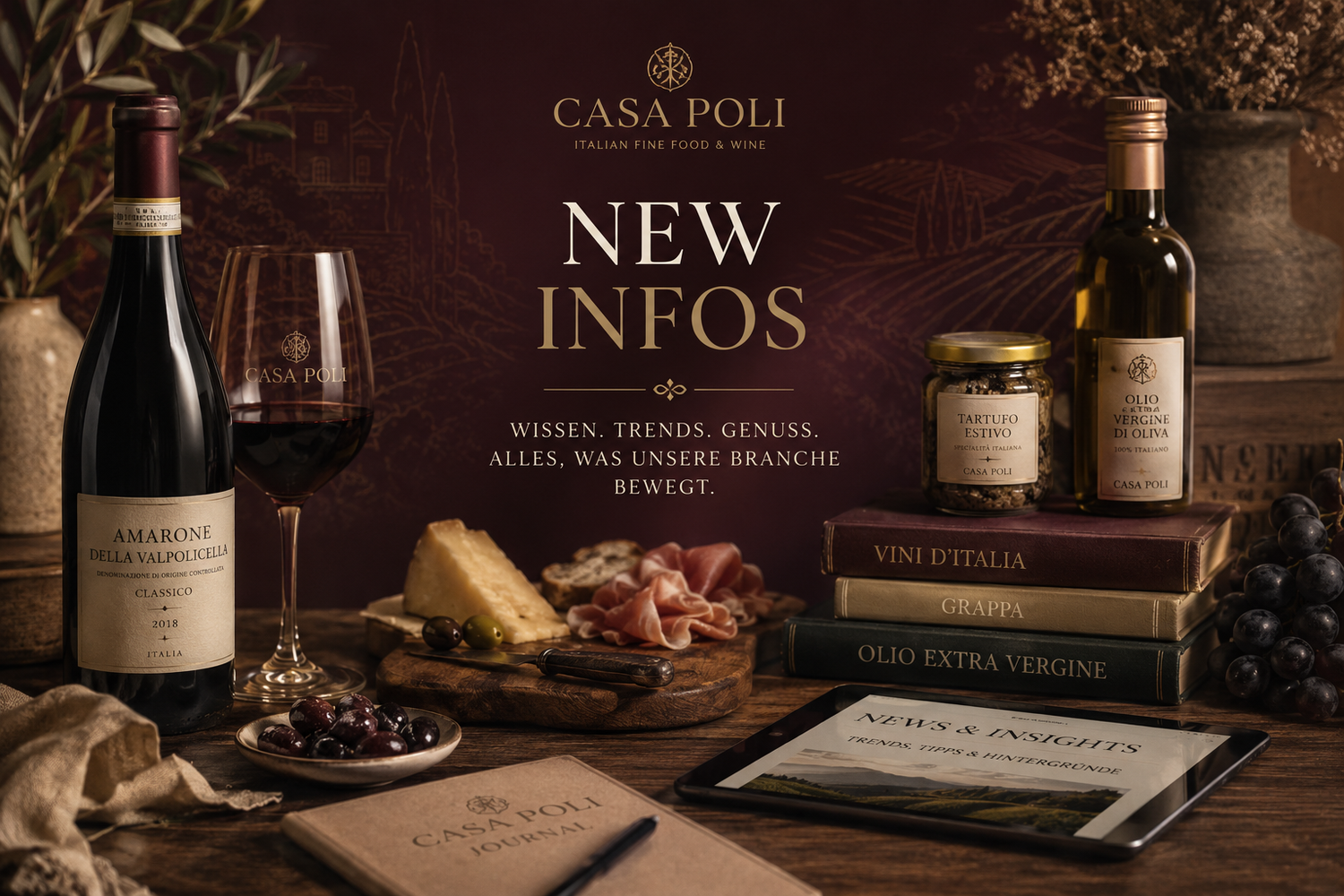
You know that? You’re reading a label and suddenly there are words like DOCG, Tannin or Barrique – and you wonder what all that actually means. Don’t worry, that happens to a lot of people. That’s why we’ve put together the most important wine terms for you, completely without jargon. That way, the next time you browse our selection, you’ll find the wine that suits you even faster.
DOCG, DOC & IGT – the Italian quality classifications
You’ll find these abbreviations on almost every Italian wine. Simply put, they are a quality guarantee. DOCG is the highest level – here, strict controls are in place regarding where the grapes come from and how the wine is made. DOC is one level below, but also clearly regulated. IGT gives winemakers a bit more freedom and often produces really exciting, unique wines – many of our Tuscan favorites carry exactly this abbreviation.
Tannin
Tannins are the tannins in wine that come from skins, seeds, and oak barrels. They create that slightly drying feeling on the palate – like your tongue is briefly “contracting”. Young red wines are often high in tannins; over time, they become softer and more balanced. A bit of tannin gives the wine structure and backbone.
Sangiovese
This is the the grape of Tuscany. Sangiovese is in many of our red wines, bringing vibrant flavors of cherry and red berries, plus a subtle spiciness. Sometimes fresh and straightforward, sometimes bold and complex – this grape can do both.
Bolgheri
A small coastal area in Tuscany, known for great wines. Elegant, full-bodied red wines are produced here – often from Cabernet and Merlot. If you enjoy rich, full-flavored wines, a Bolgheri is exactly what you’re looking for.
Cuvée
A Cuvée is simply a blend of multiple grape varieties. The winemaker combines different grapes so their strengths complement each other – one brings fruit, another structure, the third spiciness. The result is a wine that is more than the sum of its parts.
Barrique
This is what they call a small oak barrel in which wine ages. Contact with the wood gives it subtle notes of vanilla, toast, or chocolate and often makes it rounder and more complex. Many of our premium red wines – and incidentally some Grappa too – get their final touches in the barrique.
„Contains sulfites“
This note is on almost every wine bottle and confuses many. But it’s quite normal: sulfites are partially formed naturally during fermentation and are added in small amounts to keep the wine fresh and stable. Once a certain level is reached, it just needs to be declared – it’s by no means a sign of poor quality.
Got curious?
Now that you know the key terms, exploring is twice as fun. Browse our selection of Italian and South Tyrolean wines – and if you’re unsure which wine is right for your evening, just get in touch with us. We’re happy to advise you. Salute! 🍷
0 comments